SEO vs AEO in 2026: Creating Content for Search and AI Answers
Explore how SEO and AEO work together to make your content discoverable, clear, and useful across search results and AI-generated answers.
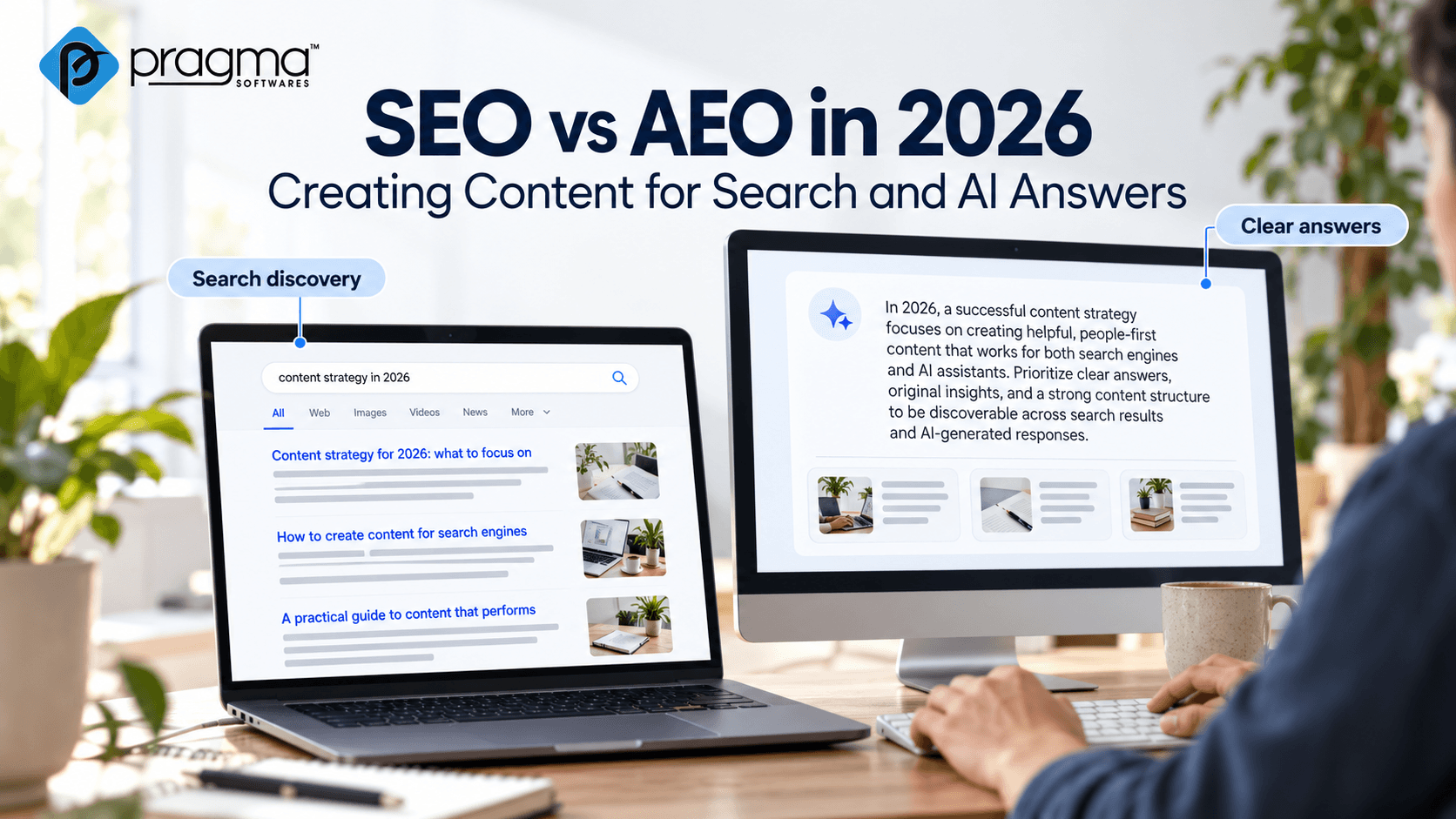
A reader searches for “website maintenance checklist.” Another asks an AI-powered search tool, “What should I test after updating my WordPress website?”
Both want useful information. One may browse several pages. The other may begin with a generated answer and follow its supporting links.
For website owners and content teams, this raises a question: how can we make information easy to discover, understand, and trust?
SEO and AEO approach this question from closely connected perspectives.
What Is SEO?
Search Engine Optimisation (SEO) helps search engines discover and understand website content so it can appear in relevant organic search results.
It combines technical website improvements with useful content and clear navigation.
Typical SEO work includes:
- Understanding what readers need.
- Writing descriptive page titles and headings.
- Creating informative, original content.
- Connecting relevant pages through internal links.
- Addressing crawling and indexing problems.
- Keeping information accurate and current.
A website migration guide, for example, should explain the process clearly and help readers identify their next steps.
What Is AEO?
Answer Engine Optimisation (AEO) is an industry term for improving how content serves answer-led experiences, including direct answers and AI-generated responses.
It emphasises clear explanations, relevant context, and evidence that supports the answer.
AEO does not come with universal rules that guarantee visibility. Google states that existing SEO practices remain relevant to AI Overviews and AI Mode, with no additional requirements or special optimisation needed for those features.
Strong search foundations and useful answers belong in the same content strategy.
What Has Changed in Search?
AI-powered search gives readers another way to explore information. A question may include several requirements at once:
“Should we use a traditional CMS or a headless CMS for a website with frequent content updates and multiple integrations?”
Answering that well requires more than a definition. The reader needs comparisons, limitations, and context.
Google explains that its AI search features may issue multiple related searches to develop a response and identify supporting pages.
For website teams, the practical implication is to cover a topic meaningfully rather than build a page around one repeated phrase.
How SEO and AEO Work Together
SEO addresses discoverability, technical accessibility, relevance, and the experience of visiting a page.
AEO draws attention to whether specific explanations can be understood and referenced accurately.
Both benefit from:
- A clear audience and purpose.
- Accurate, readable information.
- Helpful headings and logical organisation.
- Relevant examples.
- Accessible website content.
- Evidence for factual claims.
The goal is a page that helps someone exploring the full topic and someone arriving with one specific question.
Start With Questions People Actually Ask
A broad topic is a starting point. Real questions reveal what the page needs to explain.
For website maintenance, readers might ask:
- What does maintenance include?
- How should updates be tested?
- Who verifies forms and integrations?
- What happens if something breaks?
- How are backups and recovery handled?
Use questions from enquiries, support conversations, and project discussions to identify gaps.
Choose the ones that fit the page’s purpose. Adding every possible question can make an article harder to follow.
Answer Clearly, Then Explain
A reader should be able to find the main explanation without searching through a long introduction.
For example, a section titled “What Should You Test After a Website Update?” could begin:
Start by checking the functionality affected by the change, then verify important user journeys such as navigation, forms, logins, and checkout where applicable.
The next paragraphs can explain how to prioritise checks, what evidence to record, and when further investigation is needed.
A useful sequence is:
- Give the answer.
- Explain when it applies.
- Add a practical example.
- Describe limitations or exceptions.
- Suggest a relevant next step.
This approach helps readers. It does not guarantee selection by an AI system.
Make Your Experience Visible
Generic advice often leaves readers asking, “How would this work in practice?”
Original detail can answer that question.
For Pragma Softwares’ blog, an article could explore:
- What a development-to-QA handoff should include.
- How to verify a form integration after an update.
- Which decisions affect a CMS migration.
- How staging checks support release planning.
- What makes a technical issue report actionable.
Use accurate examples and explain the reasoning behind decisions.
Google’s people-first content guidance asks creators to consider originality, completeness, clear sourcing, and the value their pages provide beyond existing material.
Keep the Website Technically Accessible
Useful content still needs a functioning delivery platform.
Content, development, and marketing teams should check that:
- Intended pages are available to relevant crawlers.
- Indexing settings match the purpose of each page.
- Important content is accessible as text.
- Internal links help readers find related information.
- Broken links and confusing duplicates are addressed.
- Mobile layouts support comfortable reading.
A clear article and a reliable website support each other.
Use Structured Data Accurately
Structured data provides machine-readable information about page content. Appropriate markup may describe an article, organisation, or breadcrumb navigation.
It should reflect what readers can see and follow the requirements of the relevant search feature.
Special “AI schema” is not required for Google’s AI search features. Adding markup also does not guarantee that a page will be cited.
Focus first on accurate content and correct implementation.
Measure More Than Rankings
Search performance should be reviewed alongside what readers do after discovering a page.
Useful measures include:
- Relevant search impressions and queries.
- Organic visits.
- Engagement with important content.
- Enquiries or other meaningful actions.
- AI citation activity where reporting is available.
Bing’s AI Performance reporting provides information about citations across supported AI experiences, including referenced URLs and trends over time. Its citation metrics do not represent rankings or establish the importance of a page within an answer.
Treat citation visibility as one piece of evidence. Check separately whether it leads to visits and useful engagement.
Common Mistakes to Avoid
Replacing Useful Detail With Keywords
Relevant terminology helps describe a subject. Repetition cannot replace an explanation.
Turning Every Page Into an FAQ
Use question-based sections where they improve navigation and understanding. Keep the overall article connected.
Changing Dates Without Updating Content
Review the information itself before presenting an article as current.
Promising Guaranteed AI Visibility
No template, heading structure, or schema type can guarantee inclusion in generated answers.
Forgetting the Reader
A page should remain useful when someone arrives directly, without a search engine or AI tool guiding them.
A Starting Point for Your Next Update
Choose one important page and review it together.
Ask:
- Who needs this information?
- Which question should the page answer?
- Is the explanation clear and accurate?
- What useful detail makes it distinctive?
- Can readers and search engines access it?
- Is the next step relevant and easy to find?
Make focused improvements and evaluate the results before applying the same approach more widely.
Create content people can find. Explain it clearly enough that they want to stay, learn, and take the next step.